
When I was in high school and college, writing was one of my strengths. I enjoyed writing. Between high school and college I interned at a magazine. In college I minored in English.
I think good writing, and all good art really, is a profound act of vulnerability, and therefore courage. It requires letting yourself be seen, putting yourself on display, opening yourself up to criticism and rejection, or perhaps worse, disinterest.
Writing requires curiosity, vulnerability, courage, exploration. It requires accepting yourself at the same time that you subject yourself to your own criticism and open yourself to the criticism of others.
I’ve been continuing my job search, and that’s meant continuing to use AI to write cover letters for my applications. I have the AI draft the cover letter, and then I review it for things I don’t like, and ask Claude Code to update my writing skills and fix what I found in the draft. Once I’m satisfied that the cover letter is entirely accurate and up to my standards, I send it.
(Aside: I never use AI to write this newsletter.)
By necessity that editing process has required me to think through what makes writing good.
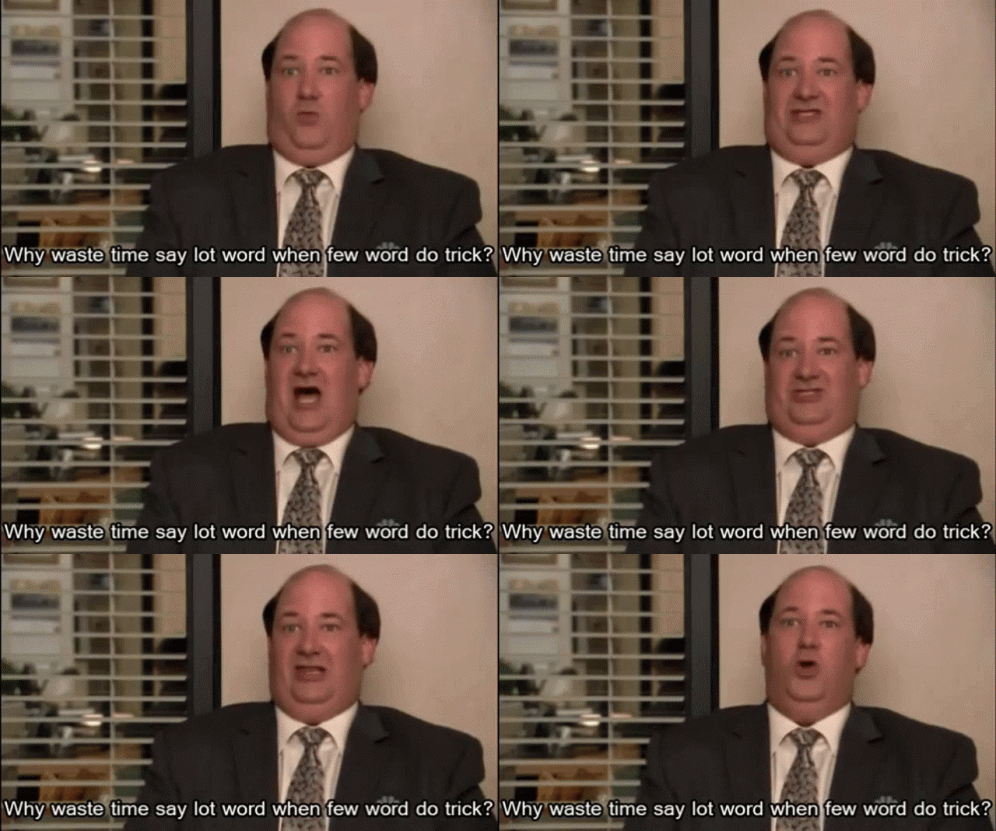
It shouldn’t use many words to say something that fewer words could say just as well.
Conversely, it shouldn’t cut words that are necessary to communicating the desired idea.
It shouldn’t use fancy words when simple words would do.
Conversely, it shouldn’t shy away from fancy words when a fancy word communicates the idea better.
It should be confident, straight-forward, and unapologetic, unless there is a specific reason to communicate insecurity or ambiguity.
It should avoid being overly evocative, except when being evocative supports the goal of the piece.
It should be aware of the context for which it is being written—the relationship between the author and the reader, the reader’s likely state of mind, and the broader societal context.
It should avoid careless repetition, such as the same word being used multiple times in one sentence (see: “context” in the previous point).
It should be easy to read. Words and structure should feel natural, not surprising or jarring.
The one thing I would expect to be in that list is acknowledging uncertainty. Intellectual honesty is a value that has become more important to me over time, so I would expect to see it in my personal goals for good writing.
I think that absence is correct. Not every piece of writing needs to embody intellectual honesty. Some writing takes a stand and makes the best case for that position, lawyer-style, while omitting counter-evidence. Some writing is exploratory, trying on a thought process for size, and not meant to be an honest appraisal of the idea’s objective value. Some writing is meant to clearly communicate the inner state of the author, and none of us are entirely honest with ourselves all the time. I think all these forms of writing can be valuable.
On the other hand, I’ve been tempted to conclude that intellectual honesty is the enemy of good writing. That it inevitably results in over-thinking, wishy-washy prose that doesn’t go anywhere. If I believe that perfect certainty is never warranted, then how can I be unapologetic and confident in my writing?
I don’t think this is true, either.
All of the following statements are confident, unapologetic, and straight-forward:
I’m 80% certain.
I’m not sure.
I don’t know.
This is my current belief.
It isn’t my acceptance of uncertainty that results in my writing lacking substance or drive. It’s my undeveloped thinking, an unwillingness to be vulnerable, and a fear of publishing something that will some day prove that I was wrong.
I’m not sure how to address all these barriers. Undeveloped thinking is fairly straightforward. I can spend more time thinking, letting ideas have the room they need to mature before publishing them. The personal insecurity? That may take more time.